
CASE STUDY · MOBILE APP · END-TO-END
UP! climbing app
An app designed for progress and motivation — helping climbers track achievements and share milestones with friends, one boulder at a time. From user research to high-fidelity prototype in two weeks.
Conceptual project — impact KPIs were defined for post-launch measurement.
81%
of climbers surveyed wanted structured, centralized tracking
74%
were motivated by social interaction, especially peer comparison
38 + 7
survey respondents + in-depth climber interviews in week one
Role
UX Researcher · UX/UI Designer
Platform Mobile app
Timeline 2 weeks · November 2024
TL;DR — THE 30-SECOND VERSION
Problem — climbers had no digital tool to meaningfully track progress and share it beyond their local gym.
Discovery — tracking was scattered across notes and photos; motivation came from friends, not public rankings.
Solution — a centralized achievement tracker with contextual logging, a progress dashboard, friends groups, and a private friends-only leaderboard.
Result — a full high-fidelity prototype in two weeks, every feature traceable to a research insight.
Overview
I designed a wellness app from scratch and chose climbing — a niche with passionate users but limited digital solutions. UP! helps climbers track progress, visualize achievements, and share milestones with friends across gyms, while ranking within their own private friend group. Research was the starting point: every feature was shaped by what climbers actually said and did.

Research
A mixed-methods approach in week one — surveys for breadth, interviews for depth, benchmarking for the competitive gap.
Competitor benchmarking. Crimpd and Social Boulder — both static, single-user, gym-bound experiences.
Survey — 38 climbers. 65% tracked progress informally; 81% wanted structure; 74% motivated socially.
7 user interviews. Intermediate climbers in France — already tracking, but in scattered, improvised ways.
Persona & user flows. Lucas, the community-motivated tracker — grounding every flow decision.
Usability testing. Wireframes and prototype tested and iterated with climbers through the sprint.
Synthesis. Affinity diagram to cluster pain points; MoSCoW to scope the two-week MVP.
Findings
Tracking is scattered. Climbs logged across Notes apps, chats, and photo galleries — impossible to see progress over time.
No way to share across gyms. Friends at other gyms meant screenshots and chats — no shared space.
Public leaderboards feel stressful. Climbers wanted low-pressure motivation within a trusted circle, not global rankings.
Progress needs context. A climb count isn't enough — difficulty, attempts, and hold types are what make progress meaningful.
"I like comparing with my friends, but public rankings make it stressful."
— Interview participant, intermediate climber
Solutions
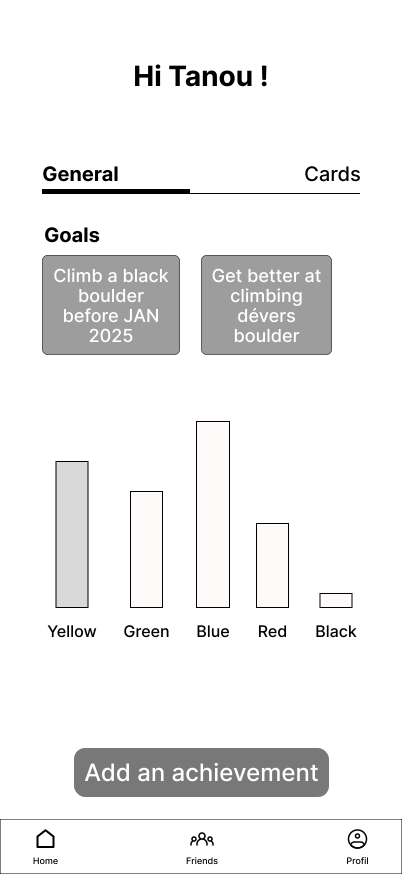
Scattered tracking → Centralized achievement tracker. One structured flow to log every climb, plus a dashboard of charts and summary cards.
No cross-gym sharing → Friends groups. Create or join a group by code, post new climbs — social connection regardless of gym.
Competitive pressure → Private friends-only leaderboard. Rankings visible only to your chosen group — gentle motivation, no anxiety.
Missing context → Detailed climb logging. Multi-step input for difficulty, number of attempts, and technical tags (crimps, jugs, overhangs).
Design process
Research-driven wireframes. Mid-fi screens built directly from the four pain points, refined through testing.
Brand & color system. Community · Perseverance · Empowerment — warm orange, dark green, light gray; Inter for clarity.
Interaction design. Multi-step logging flow, dashboard charts, and group-sharing flow — prototyped to hi-fi.


Key learnings
Motivation is social, not competitive.
Climbers want to be seen by friends — not ranked against strangers.
Details make logging meaningful.
Difficulty, attempts, and holds turn a climb count into a story of progress.
Research from scratch pays off.
With no product to inherit, week-one research shaped every feature decision.
From zero to a high-fidelity, testable prototype in two weeks — with launch KPIs defined to measure adoption, logging habits, and retention.
Let's work together
CASE STUDY · MOBILE APP · END-TO-END
UP! climbing app
An app designed for progress and motivation — helping climbers track achievements and share milestones with friends, one boulder at a time. From user research to high-fidelity prototype in two weeks.
Conceptual project — impact KPIs were defined for post-launch measurement.
81%
of climbers surveyed wanted structured, centralized tracking
74%
were motivated by social interaction, especially peer comparison
38 + 7
survey respondents + in-depth climber interviews in week one
Role UX Researcher · UX/UI Designer
Platform Mobile app
Timeline 2 weeks · November 2024
TL;DR — THE 30-SECOND VERSION
Problem — climbers had no digital tool to meaningfully track progress and share it beyond their local gym.
Discovery — tracking was scattered across notes and photos; motivation came from friends, not public rankings.
Solution — a centralized achievement tracker with contextual logging, a progress dashboard, friends groups, and a private friends-only leaderboard.
Result — a full high-fidelity prototype in two weeks, every feature traceable to a research insight.
Overview
I designed a wellness app from scratch and chose climbing — a niche with passionate users but limited digital solutions. UP! helps climbers track progress, visualize achievements, and share milestones with friends across gyms, while ranking within their own private friend group. Research was the starting point: every feature was shaped by what climbers actually said and did.

Research
A mixed-methods approach in week one — surveys for breadth, interviews for depth, benchmarking for the competitive gap.
Survey — 38 climbers. 65% tracked progress informally; 81% wanted structure; 74% motivated socially.
Competitor benchmarking. Crimpd and Social Boulder — both static, single-user, gym-bound experiences.
7 user interviews. Intermediate climbers in France — already tracking, but in scattered, improvised ways.
Persona & user flows. Lucas, the community-motivated tracker — grounding every flow decision.
Usability testing. Wireframes and prototype tested and iterated with climbers through the sprint.
Synthesis. Affinity diagram to cluster pain points; MoSCoW to scope the two-week MVP.
Findings
"I like comparing with my friends, but public rankings make it stressful."
— Interview participant, intermediate climber
Tracking is scattered. Climbs logged across Notes apps, chats, and photo galleries — impossible to see progress over time.
No way to share across gyms. Friends at other gyms meant screenshots and chats — no shared space.
Public leaderboards feel stressful. Climbers wanted low-pressure motivation within a trusted circle, not global rankings.
Progress needs context. A climb count isn't enough — difficulty, attempts, and hold types are what make progress meaningful.
Solutions
Scattered tracking → Centralized achievement tracker. One structured flow to log every climb, plus a dashboard of charts and summary cards.
No cross-gym sharing → Friends groups. Create or join a group by code, post new climbs — social connection regardless of gym.
Competitive pressure → Private friends-only leaderboard. Rankings visible only to your chosen group — gentle motivation, no anxiety.
Missing context → Detailed climb logging. Multi-step input for difficulty, number of attempts, and technical tags (crimps, jugs, overhangs).
Design process
Research-driven wireframes. Mid-fi screens built directly from the four pain points, refined through testing.
Brand & color system. Community · Perseverance · Empowerment — warm orange, dark green, light gray; Inter for clarity.
Interaction design. Multi-step logging flow, dashboard charts, and group-sharing flow — prototyped to hi-fi.